The Forgotten Square Masterpiece Every JRPG Fan Should Have Played
Too Many Great Games, Too Little Time
The SNES and PS1 eras buried players in quality. Square alone was running Final Fantasy and Chrono Trigger simultaneously, each installment a landmark. Throw in titles from Enix, Atlus, and a dozen smaller publishers, and you had more essential JRPGs than any single human could reasonably finish in a lifetime.
Which is exactly how certain games fell through the cracks. Not because they were bad. Because they were surrounded.
One Director Who Refused to Play It Safe
Vagrant Story arrived in 2000, slotted between Chrono Cross and Final Fantasy IX, two of the most anticipated releases of the era. It came from Yasumi Matsuno, the director who had already proven himself with Final Fantasy Tactics. Most developers in his position would have made FFT 2. Matsuno made something stranger.
The game reuses Ivalice, the political fantasy world from Tactics, but shares almost nothing else with it. Darker visuals. A tighter cast. A story stripped of Tactics’ sweeping battlefield drama in favor of something claustrophobic and personal. This was a deliberate choice, not a limitation.
Matsuno directed, produced, co-wrote, and served as lead designer. That kind of total authorship is rare. It shows.
A Visual Style Nobody Ever Copied
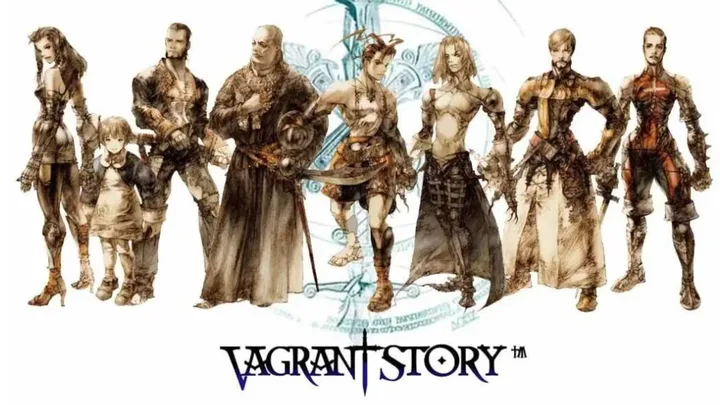
The character design of Vagrant Story shouldn’t work. Hiroshi Minagawa and Akihiko Yoshida, veterans of Ogre Battle and Final Fantasy Tactics, threw out everything familiar and built something angular, stylized, closer to European graphic novel art than anything the medium had seen.
Characters are sharp-edged, almost sculptural. Backgrounds are dense with architectural detail, stone corridors that feel like they were actually built rather than rendered. Playing it feels like moving through a hand-inked page. No game before it looked like this. No game since has tried.
That visual distinctiveness wasn’t just aesthetic. It reinforced the tone: medieval, yes, but grimier and more morally complicated than Tactics’ chessboard wars.
The Story That Gets Personal Fast
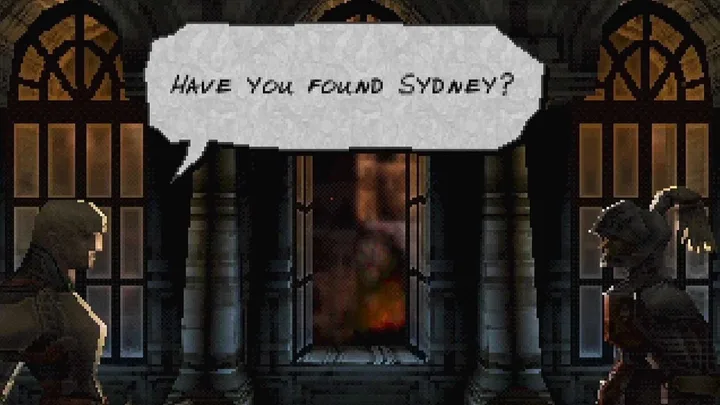
Matsuno’s scripts tend toward political complexity, and Vagrant Story starts there. A rift between the Valendian Parliament and renegade Duke Bardoba sets the stage. The Parliament sends their best operative, a Riskbreaker named Ashley Riot, to handle the situation.
But the game doesn’t stay in the throne room. Ashley’s mission pulls him into Lea Monde, an abandoned city humming with something wrong. The cast is small and every character carries hidden weight. What begins as political intrigue narrows into something far more intimate: a story about power, what it costs to hold it, and what it costs to lose someone.
The narrative trusts players to keep up. There are no easy villains. There is no clean resolution. That’s not a complaint.
The Combat System That Required Homework
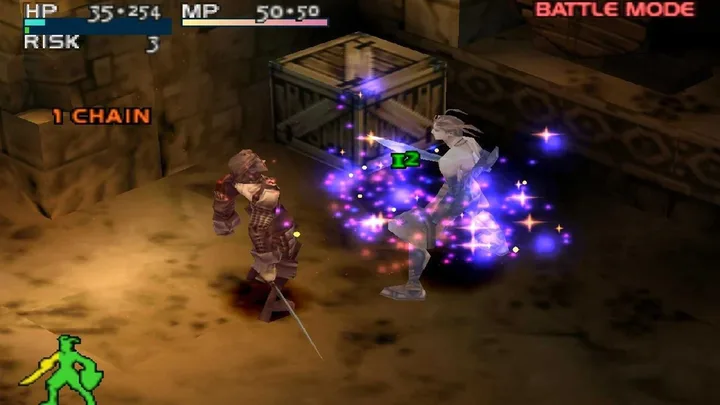
Vagrant Story’s battle system confused almost everyone on first contact. That was partly a design communication failure. It was also asking players to think in ways action-RPGs never had.
Every weapon in the game has affinities — effective against certain monster types, useless against others. You don’t pick a sword because it has high attack power. You pick it because the creature in front of you is weak to bladed Human-affinity weapons, and you’ve spent the last hour crafting it specifically for this encounter. A targeting system lets you aim at individual limbs, trading accuracy for weak-spot damage. Each weapon can be further customized. Special attacks shift in power based on enemy type.
The Risk system ties it together. Every string of attacks builds a Risk meter. Higher Risk means your damage and accuracy drop while enemies hit harder. You’re constantly deciding: push the combo and risk a killing blow, or break off and reset. It’s not difficult once you understand it. Getting there takes real effort.
Beloved, Ignored, Unreachable
Vagrant Story sold over 100,000 copies within its first month, strong numbers for an unusual game launched at the tail end of the PS1’s lifespan. The PlayStation 2 was already pulling players away. A sequel was discussed. It never happened.
Square’s focus shifted to Final Fantasy, Kingdom Hearts, and new IP experiments. The closest fans ever got to a proper return was in Final Fantasy XIV, where Matsuno briefly contributed to several expansions. The “Return to Ivalice” alliance raid let players walk through a version of Lea Monde. Years later, “Save the Queen” extended that thread a little further.
The original game exists on PS1 hardware and a PS3 digital store that no longer sells new content. No modern port. No remaster. No legal way to play it on current hardware without digging up old consoles. For a company that has remastered practically everything else in its catalog, it’s a strange omission. Square Enix has made stranger decisions, and eventually reversed most of them.