Your Dog Has a Built-In Compass and Seven Other Wild Secrets
More Human Than You Think
Dogs and humans share roughly 84% of their DNA — including more than 17,000 similar genes. Both species carry multiple copies of the AMY2B gene, which helps digest starch, an adaptation that likely deepened as dogs hung around early agricultural settlements. They also share EPAS1, tied to high-altitude adaptation, and POMC, which governs food motivation and metabolism. Your dog’s obsessive interest in your lunch has ancient, encoded origins.
The genetic company Embark has catalogued shared variants across its canine DNA database that mirror human biology in ways researchers are still mapping. Dogs get many of the same cancers humans do, develop similar cardiovascular conditions, and age through comparable physiological stages. That 84% figure starts to feel less like a trivia answer and more like actual kinship.
The Wolf Never Left
Genetic and archaeological evidence places the domestication of dogs somewhere between 27,000 and 40,000 years ago, descended from gray wolves. But the split was never clean. Embark senior scientist Brett Ford found that Pomeranians — those wispy, handbag-sized fluffballs — carry ten times more wolf-like genetic variants in domestication-linked regions than breeds like Bullmastiffs or Irish Setters. The tiniest lap dog on the block still has a predator buried in its genome.
What’s striking isn’t that wolves became dogs. It’s how unevenly that transformation happened. Different breeds retained different pieces of their wild ancestry, which helps explain why some dogs — even pampered ones — still have that feral edge the moment something bolts across the yard.
Your Dog Has Family on Other Continents
Among millions of dogs tested through Embark, 94% matched with at least one genetic relative. About one in three had an immediate family member who’d also been tested. Roughly 1% had a close relative living in a different country. Your rescue mutt from the local shelter might have a cousin in Portugal.
That international scatter isn’t just a modern quirk of shipping and air travel. A University of Oxford study found that dogs migrated southward through the Americas over thousands of years, moving alongside human communities as agriculture spread. Modern Chihuahuas still carry traces of pre-European-contact dogs from Mesoamerica. Their geography is a genetic diary of human history.

Destructive Behavior Has a Resume
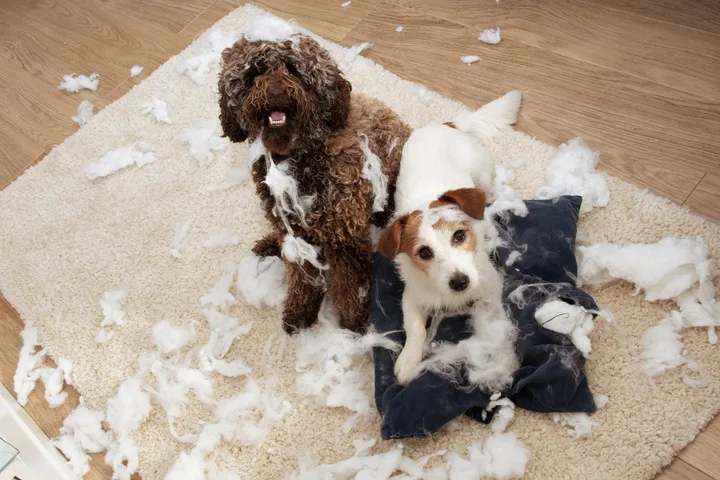
The shredded couch cushion. The hole under the fence. The obsessive staring at squirrels. Before you scold your dog, consider its job description. Embark’s Thom Nelson points out that even a trace of Greyhound ancestry makes a mixed-breed dog significantly more likely to chase small animals. Australian Cattle Dogs were bred to nip ankles — that’s not aggression, that’s herding instinct firing in a suburban living room with no cattle in sight.
Research from the National Human Genome Research Institute supports this: breed-specific behaviors are at least partly shaped by inherited genetic differences. The job the dog was built for may have vanished centuries ago, but the wiring stayed. A Border Collie trying to herd your children is doing exactly what its genome was designed to do.
They Choose Where to Poop by Compass
This sounds like a joke. It isn’t. A peer-reviewed study published in Frontiers in Zoology tracked 70 dogs across 37 breeds over two years, logging more than 7,000 bathroom breaks and recording the direction each dog’s body faced. When those observations were stacked against daily geomagnetic readings, a clear pattern surfaced: under calm magnetic conditions, dogs consistently aligned along the north-south axis when they defecated. When the field fluctuated, the preference vanished.
When Earth’s magnetic field is calm and stable, dogs often align along the North-South axis when they poop. This ability to detect Earth’s magnetic field may contribute to their impressive navigation skills. — Thom Nelson, Ph.D., Embark
The finding suggests dogs have a magnetoreception system — a built-in sensitivity to Earth’s geomagnetic field — that likely plays a broader role in navigation. They’re not just sniffing their way home. They may be orienting by forces humans can’t feel at all.
The Size Range Is Almost Absurd
No other land mammal on Earth varies in size as dramatically as the domestic dog. Embark’s dataset makes this concrete: the smallest dog in their records was a 2-pound Chihuahua with a predicted adult weight of 3.7 pounds. The largest was a Great Dane-Mastiff mix at 250 pounds, predicted at 187. Same species. Same basic animal. A weight ratio that stretches past 200-to-1.
It took centuries of selective breeding to push those extremes, but the underlying genetic architecture is surprisingly compact. A relatively small number of genes, working together, account for most of the dramatic variation in dog size. The levers were always there. Humans just kept pulling them in opposite directions.
Scent Hounds Live in a Different World
A dog’s nose holds up to 300 million olfactory receptors. Humans have roughly 5 million. Dogs also dedicate a far larger portion of their brain to processing smell. But even within that general advantage, the gap between breeds is striking. Embark data shows that 94% of scent-hound breeds — Bloodhounds, Beagles — keep their noses to the ground during walks. Other breeds and mixes do it about 71% of the time.
For a Bloodhound, following a trail isn’t a walk. It’s closer to reading. Each step delivers a page of information about who passed through, how long ago, how fast they moved. When a Bloodhound locks onto a scent, it’s operating in a sensory register humans can barely conceptualize. Not a better version of what we experience. A completely different one.

Some Dogs Genuinely Watch Television
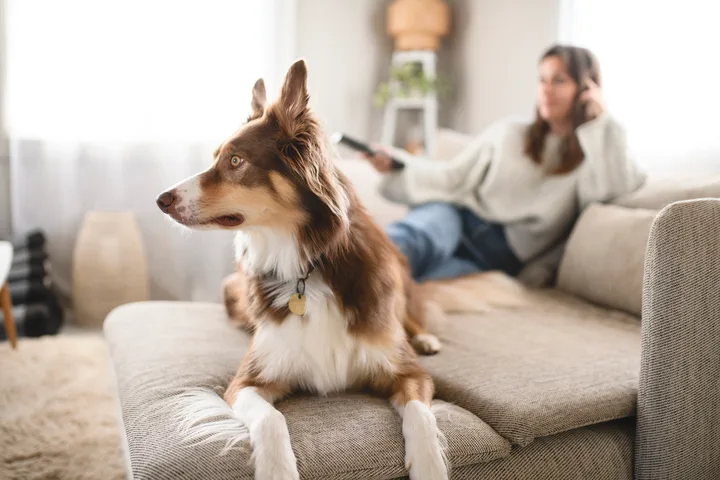
An Embark survey found that only 27% of dog owners say their dog never watches TV. Nine percent report their dogs actively binge shows — sometimes parked right alongside their owners on the sofa. Terriers, bred to hunt vermin, often fixate on movement on screen or snap to attention at squeaky sound effects. The TV registers as prey behavior. A hunt with no payoff, but a hunt.
Bloodhounds, on the other hand, mostly ignore screens. No scent, no interest. What an image shows without smell isn’t worth tracking. Even in front of a television, dogs are still running the program evolution wrote for them — each breed watching the same screen and seeing something entirely different.