The Lincoln Memorial Is Hiding Secrets Most Visitors Walk Right Past
Built on a River Nobody Wanted
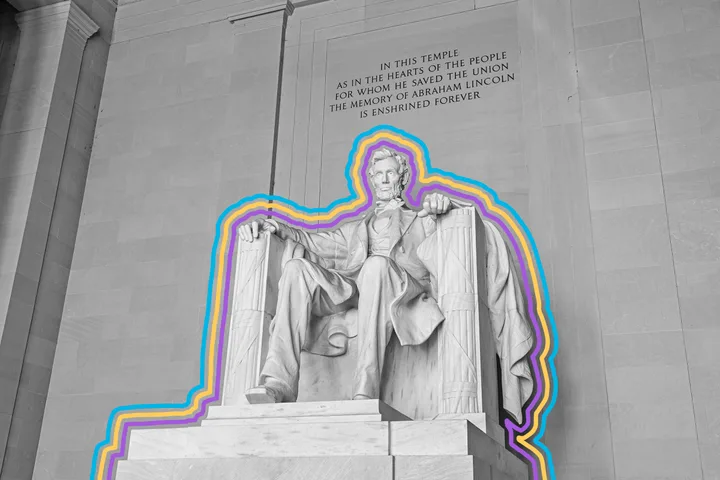
Before the Lincoln Memorial existed, the ground it stands on didn’t exist either. The site was called Kidwell Flats — a sodden, mosquito-thick stretch of the Potomac River that city planners described charitably as “marshy.” The original 1791 blueprint for the National Mall stopped at the Washington Monument, because everything west of it was basically a swamp.
That changed in the 1880s and ’90s, when the U.S. Army Corps of Engineers dredged the Potomac and dumped the excavated soil onto the floodplain west of the monument. The land they created didn’t just become home to the Lincoln Memorial — it’s now also the site of the World War II Memorial, the Martin Luther King Jr. Memorial, and the Jefferson Memorial. Four of Washington’s most visited landmarks sit on what was once river bottom.
The Reflecting Pool, built in the 1920s atop that same dredged soil, immediately started sinking. Without pilings, it dropped roughly a foot into the muck and cracked badly enough to hemorrhage water — about 30 million gallons a year. A full reconstruction in 2012 gave it a reinforced base and a modern water recycling system.
Henry Bacon Looked to Athens
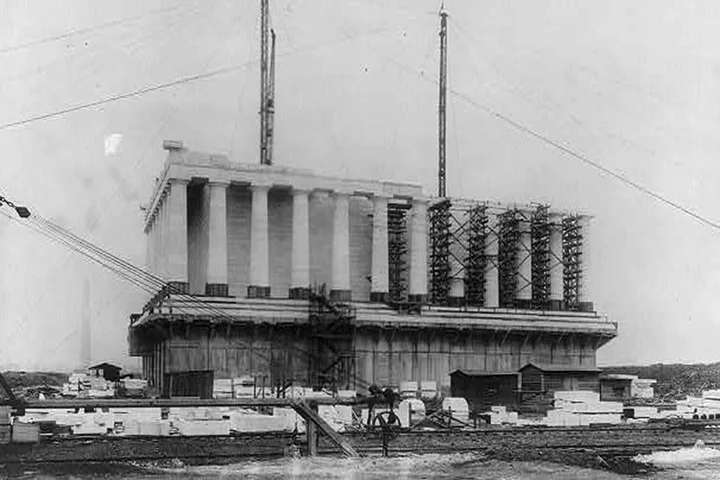
Completed in 1922, the Lincoln Memorial doesn’t look like anything else on the Mall. That was intentional. New York architect Henry Bacon modeled it explicitly on the Parthenon in Athens — the logic being that the man who defended American democracy deserved a monument rooted in democracy’s ancient birthplace. The result is 190 feet long, 120 feet wide, and 99 feet tall, clad in a carefully sourced mix of stone: Colorado Yule marble on the exterior and upper stairs, Massachusetts granite on the terrace, Tennessee pink marble on the chamber floor.
Bacon didn’t just borrow the Parthenon’s silhouette. He thought about what each design choice meant. The columns aren’t decorative — they carry the weight of the argument Bacon was making about Lincoln’s place in history. The building feels less like a government structure and more like something you’d find on a cliff above the Aegean.
Thirty-Six Columns, Thirty-Six States
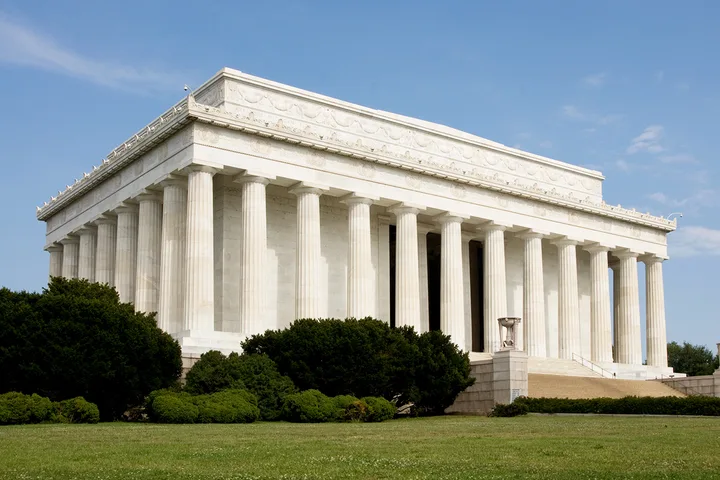
Count the Doric columns wrapping the memorial’s exterior. There are 36 of them, each standing 44 feet tall with a base diameter of over seven feet. The number is deliberate. Bacon chose 36 to represent the states in the Union at the moment Lincoln died — April 14, 1865.
By 1922, when the memorial opened, the country had grown to 48 states. Bacon accounted for that too: the names of all 48 contiguous states are carved into the frieze above the colonnade. Alaska and Hawaii, admitted to the Union in 1959, were honored with a separate commemorative plaque added to the plaza in 1976.
The Typo Carved in Stone
Lincoln’s Second Inaugural Address covers the north interior wall in carved limestone. It’s one of the most powerful passages in American political writing — and for years, one word was wrong. Engraver Ernest C. Bairstow, who handled the memorial’s lettering with otherwise flawless precision, accidentally carved “EUTURE” instead of “FUTURE.” The National Park Service believes he grabbed an “E” stencil instead of an “F.”
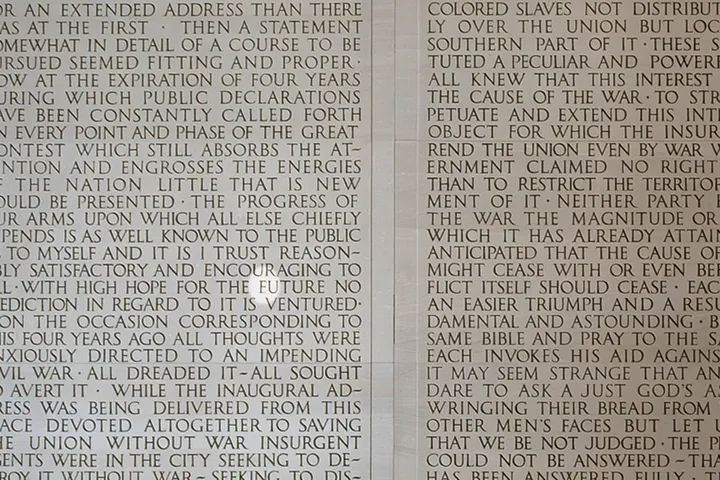
The error was corrected by filling in the bottom horizontal bar of the letter, converting the “E” back to an “F.” But the fix isn’t invisible. In the right light, the ghost of that extra line is still there — a permanent record of a single distracted moment during the 1920s. It’s the kind of detail that makes a monument feel human.
“With high hope for the future, no prediction in regard to it is ventured.” — Abraham Lincoln, Second Inaugural Address, 1865
The Basement Nobody Has Seen
NPS rangers field the same question constantly: is Lincoln buried underneath the memorial? He’s not — his remains are in Springfield, Illinois, and always have been. What’s actually beneath the memorial is a cavernous concrete undercroft spanning 43,800 square feet, its ceiling supported by massive pillars, its walls still bearing graffiti left by the original construction workers. For a century, it’s been essentially empty.
That changes in July 2026. A new museum will open 15,000 square feet of that space to the public, focused on the memorial’s construction, its history, and its role in civil rights protests — most famously as the spot where Martin Luther King Jr. delivered the “I Have a Dream” speech in 1963. Floor-to-ceiling glass walls will expose the remaining undeveloped section of the foundation, giving visitors a look at the bare bones beneath one of the country’s most photographed buildings. A monument that has always felt complete is about to reveal what it was hiding all along.