Eight Dog Facts That Prove Your Pet Is Weirder Than You Think
You Share More DNA With Your Dog Than You’d Guess
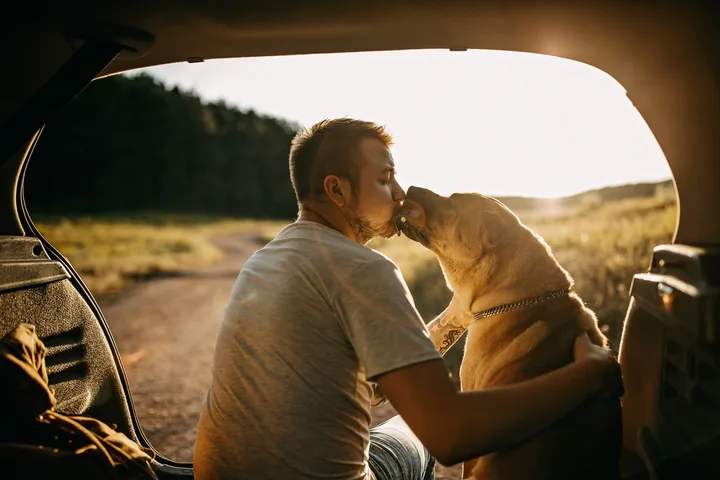
Humans and dogs share roughly 84% of their DNA — over 17,000 similar genes woven through both species. That’s not a rounding error. Scientists have identified shared variants in genes tied to starch digestion (AMY2B), high-altitude adaptation (EPAS1), and food motivation (POMC). The starch connection makes evolutionary sense: as humans built agricultural societies, dogs stuck close and adapted right alongside them, down to the molecular level.
It’s a strange thing to sit with. Your dog isn’t just your companion. At the genetic level, you’re distant cousins.
Every Dog Still Carries a Little Wolf
Domestic dogs likely split from gray wolves somewhere between 27,000 and 40,000 years ago. The archaeological evidence is murky, the genetic evidence is not. And here’s the part that surprises people: the tiniest, fluffiest lap dogs carry some of the most wolf-like DNA. Embark senior scientist Brett Ford found that Pomeranians carry ten times more wolf-like genetic variants — in regions linked to domestication — than breeds like the Bullmastiff or Irish Setter.
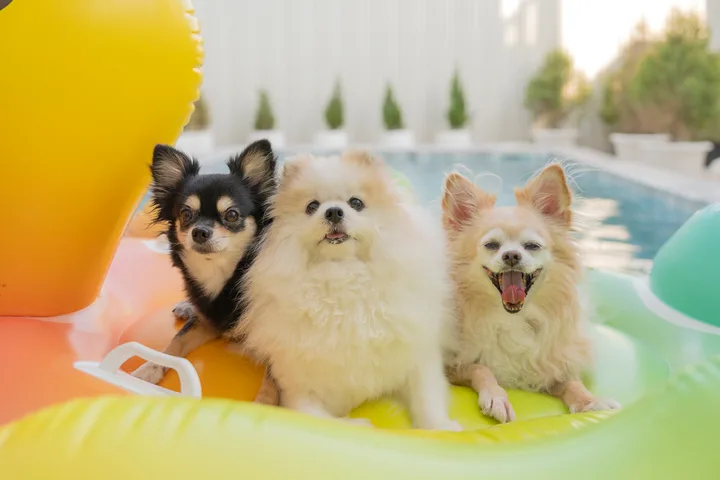
A three-pound dog in a rhinestone collar, genetically closer to a wolf than a Great Dane. Dogs contain multitudes.
Your Dog Has Relatives on Other Continents
Ninety-four percent of dogs tested through Embark were matched with at least one genetic relative. One in three had an immediate family member who’d also been tested. And roughly 1% — a genuinely surprising number — have a close relative living in a different country. Canine family trees are wide, tangled, and international.
The global spread isn’t new. A University of Oxford study traced dogs moving southward through the Americas over thousands of years, traveling alongside human communities as agriculture expanded. Some modern Chihuahuas still carry genetic traces of pre-European-contact dogs from Mesoamerica. Your rescue mutt might be carrying history.
What Looks Like Bad Behavior Is Actually a Job Description
Barking at nothing. Digging up the yard. Fixating on squirrels with the intensity of a detective on a cold case. These aren’t personality flaws — they’re inherited occupational hazards. According to Embark senior scientist Thom Nelson, even trace amounts of Greyhound ancestry can make a mixed-breed dog far more likely to chase small animals. Australian Cattle Dogs nip at heels because that’s exactly what they were bred to do — move livestock in tight spaces.
Research from the National Human Genome Research Institute backs this up: breed-specific behaviors are shaped, at least in part, by genetic inheritance. The job description outlasts the job by generations. Your dog is still showing up for work.
Dogs Pick Where to Poop Using Earth’s Magnetic Field
A peer-reviewed study in Frontiers in Zoology tracked 70 dogs across 37 breeds for two years. Researchers logged more than 7,000 bathroom breaks, noting body alignment each time. When they cross-referenced that data with daily geomagnetic readings, a pattern emerged: under calm magnetic conditions, dogs consistently preferred to align along the North-South axis when defecating. When the magnetic field fluctuated, the preference disappeared.
“When Earth’s magnetic field is calm and stable, dogs often align along the North-South axis when they poop,” said Thom Nelson, Ph.D., senior scientist at Embark. “This ability to detect Earth’s magnetic field may contribute to their impressive navigation skills.”
Your dog isn’t dawdling on walks. It’s calibrating.
No Other Land Mammal Varies This Much in Size
Domestic dogs show more variation in body size and shape than any other land mammal on Earth. Not a little more — dramatically more. Embark’s dataset captures the full absurdity of it: the smallest dog on record was a 2-pound Chihuahua with a predicted weight of 3.7 pounds. The largest was a Great Dane-Mastiff mix at 250 pounds. At the extremes, the biggest dog outweighs the smallest by more than 200 to one.
Selective breeding over centuries amplified genetic differences that were already there. The result is a single species that somehow includes both a creature that fits in a coat pocket and one that can rest its chin on a kitchen counter without trying.
Scent Hounds Are Running Entirely Different Software
Dogs have up to 300 million olfactory receptors. Humans have about 5 million. That’s not a modest upgrade — that’s a different relationship with reality. And within dogs, the variation is significant. Embark data shows that 94% of scent-hound breeds like Bloodhounds and Beagles keep their noses to the ground during walks. Other breeds and mixes do it about 71% of the time.
For a Bloodhound, following a scent trail isn’t a distraction. It’s the whole point of existing. Their brains devote far more processing power to smell than any other sense. When your Beagle ignores you on a walk, it’s not defiance. It’s concentration.
Some Dogs Actually Watch Television
An Embark survey found that only 27% of dog owners report their dogs never watch TV. Nine percent say their dogs actively binge shows — occasionally alongside their humans. Breed matters here. Terriers, bred to hunt quick-moving vermin, often react to on-screen movement and high-pitched sounds. Bloodhounds, built around smell rather than sight, tend to ignore the screen entirely. No odor, no interest.
It’s a small data point, but a telling one. From wolf ancestry to intercontinental relatives to a built-in magnetic compass, much of what makes a dog a dog is written into its DNA — including, apparently, whether it watches nature documentaries or stares blankly at the wall instead.