The Glass Slipper Was a Political Joke and Six Other Cinderella Secrets
A Greek Courtesan Started Everything
Forget the pumpkin carriage. The story that may have given birth to Cinderella is set in ancient Egypt, and the heroine isn’t a neglected housemaid — she’s a courtesan named Rhodopis. Around the first century BCE, Greek geographer Strabo recorded the tale: an eagle snatches one of Rhodopis’s sandals mid-air and drops it into the lap of an Egyptian pharaoh. The king takes it as a divine sign, dispatches soldiers across the kingdom to find the barefoot woman, and marries her when they do.
Not everyone buys this as the prototype. Some historians argue that Strabo’s version shares only the shoe — no cruel stepfamily, no magical helper, no midnight deadline. Strip those elements out and you barely have the same story. Still, the impulse to trace the tale that far back says something about how deeply it lodged itself in human imagination.
Seven Hundred Versions and Counting
Whether Rhodopis counts as the original or not, she kicked off an avalanche. Shoe-centric rags-to-royalty plots have surfaced on every continent, with some librarians cataloguing more than 500 European versions alone and global totals reaching 700. Each culture tweaked the details to fit. In Denmark, the heroine — called Askepot — wears rain boots, which makes perfect sense given the climate. In one Italian telling, the princess is born inside a squash and renamed Zucchettina accordingly.
The version that stuck was written by French author Charles Perrault in 1697. His “Cendrillon” introduced the glass slipper for the first time — a detail so impractical and so memorable that it eclipsed every wooden clog and rain boot that came before it.
Louis XIV Was the Actual Target
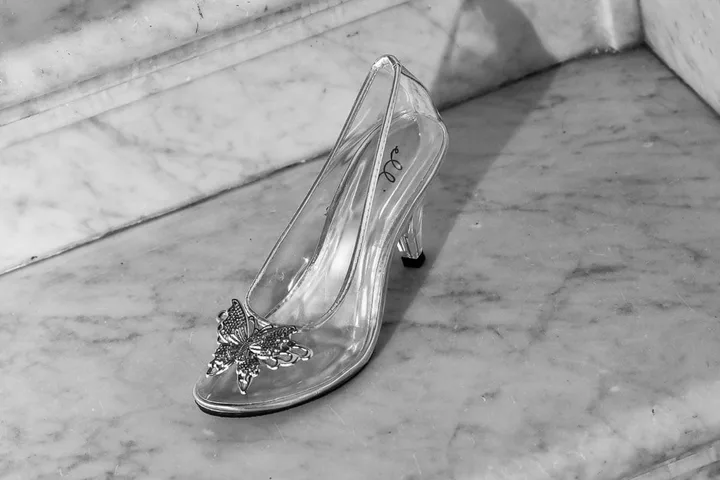
Perrault’s choice of glass wasn’t whimsy. Historian Genevieve Warwick at the University of Edinburgh argues it was satire — a pointed jab at Louis XIV, whose reign ran from 1642 to 1715 and whose wardrobe was legendary for its extravagance. The Sun King was obsessed with shoes. Elaborate, decorative, utterly impractical shoes. Perrault, who spent years overseeing construction projects at Versailles (including its Hall of Mirrors) and the Louvre, would have had a front-row seat to the king’s aesthetic excess.
A slipper made of glass — beautiful, fragile, useless for actual dancing — was a satirist’s dream prop. But Warwick reads a second layer into it too. Perrault was tasked with establishing a French royal glassworks, ending France’s dependence on Venetian craftsmen. Cinderella’s magical transformation, she suggests, doubled as a metaphor for French self-sufficiency: the nation finally producing its own luxury goods, on its own terms, for its own king.
Disney Drew Her Thirty Years Early
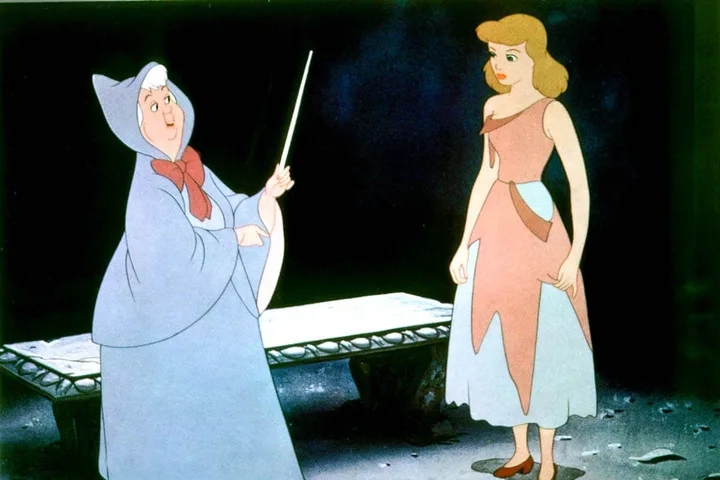
The 1950 Disney film is the version most people picture when they close their eyes — the blue gown, the Fairy Godmother, the mice. But Walt Disney had already made a Cinderella in 1922, when he was running a scrappy Kansas City operation called Laugh-O-Gram. That silent, seven-minute short swapped the pumpkin for a car and dressed Cinderella in flapper fashion. Her only companion was a cat who helped with the chores.
The same studio that year also produced shorts of “Little Red Riding Hood” and “Beauty and the Beast.” Disney was clearly working through a fairy-tale obsession from the start. It would take him nearly three more decades to return to Cinderella with the budget and team to do it properly.
The Film That Kept the Lights On
By the time Cinderella went into production, Disney’s studio was in serious trouble. World War II had gutted his output and the debts had climbed to nearly $4 million. The 1950 film — six years in development and $2 million to produce — was the kind of bet that ends careers. A flop would have shuttered the studio outright.
It didn’t flop. Cinderella grossed over $4 million at the box office and earned three Oscar nominations for its soundtrack. That windfall cleared the debt and bankrolled everything that came after — from the animated classics of the 1950s to the eventual theme parks. One fairy tale, essentially, funded a media empire.
One Night, Sixty Percent of American Homes
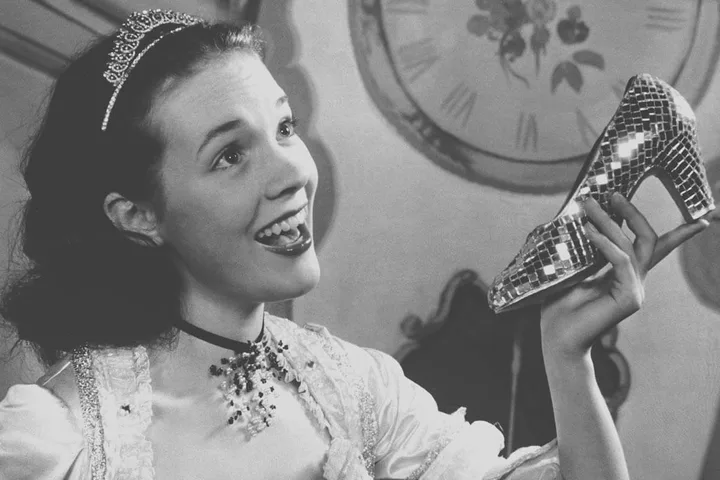
Richard Rodgers and Oscar Hammerstein II wrote eleven musicals together — Oklahoma!, Carousel, The Sound of Music — but only one for television. Their 1957 Cinderella starred a 21-year-old Julie Andrews and aired on March 31st to reviews that matched the audience numbers: enormous. More than 100 million viewers watched. That was over 60% of American households.
Over 60% of American households tuned in to a single broadcast of a fairy tale — a number most modern streaming events never approach.
The production has since been remade for both TV and Broadway multiple times, which is fitting for a story that has refused to stay in one shape for roughly two thousand years. The shoe keeps changing. The story doesn’t.