Her Boss Laughed When She Asked About Overtime Pay
Two Minutes Before Quitting Time
Clara had been at the company three years. She knew the rhythms of the office, knew which Fridays tended to bleed into evenings, knew which managers liked to perform urgency at the end of the week. But this particular Friday, two minutes before four o’clock, her manager Derek walked over and dropped a folder on her desk with the casual energy of someone tossing junk mail.
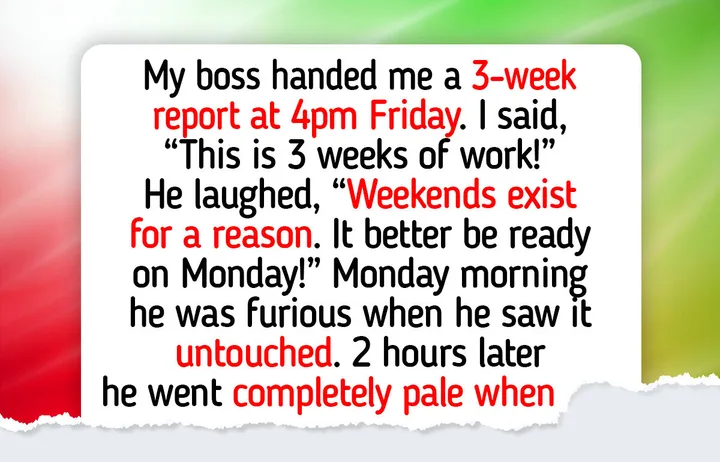
She opened it. Campaign brief. Competitor analysis. Content calendar. Budget breakdown. A full month of work, stacked neatly inside, suddenly her problem. When she looked up, Derek was already halfway across the room. “Weekends exist for a reason,” he said over his shoulder. “It better be ready Monday.”
The Question That Changed the Room
Clara called after him with one question: was there overtime pay for this?
He laughed. Not a nervous laugh, not an awkward laugh. He laughed like she’d said something absurd, and then he left. So Clara picked up her bag, left the folder exactly where it sat, and walked out at 4:01.

The Perfectly Normal Weekend
She went to the farmers market Saturday morning. Called her mom. Watched TV in her pajamas without a single work notification buzzing on her phone. She did not open her laptop. The folder sat on her desk across town, and she did not think about it once.

This is the part that tends to unsettle people — not that she refused, but how peacefully she refused. No dramatic resignation speech. No sleepless night spiraling through worst-case scenarios. She just didn’t.
Monday Was a Different Energy
Derek arrived at her desk before she’d set down her coffee. Where was the project? Clara told him she doesn’t work overtime without additional pay, that the assignment wasn’t reasonable, and that it wasn’t in her contract. Derek launched into a speech about leadership and company culture and proving yourself. She tuned out most of it.

He told her HR was going to hear about this. She told him she’d be there.
HR Already Knew His Name
Two of Clara’s coworkers had already filed complaints against Derek before any of this happened. One for identical unpaid weekend pressure. Another for lifting credit from a colleague’s project and presenting it as his own in a leadership meeting. HR wasn’t hearing about Derek for the first time.
“He went completely pale when they called him in.”

By the end of the week, Derek was on a formal performance review. Not Clara.
The Game With No Finish Line
Her coworkers split down the middle. Half said she was right. The other half said she should have done part of the work as a gesture of good faith, or warned her she’d painted a target on herself for the sake of a point. One person said she’d risked her entire job over a principle.

What nobody said out loud is that “proving yourself” by donating free weekends is a game that never ends. The moment you hand over a Saturday without complaint, the next ask is already being calculated. And when bosses can’t extract compliance through pressure, some shift to subtler tactics: smaller assignments, fewer invitations, salary reviews that somehow never move forward. It’s a slow fade designed to make leaving feel like your own idea.
Clara held her line. HR did the rest.