The Delta Upgrade System Is Rigged — Here’s How to Beat It
The Myth of the Free Seat
Somewhere over the Rockies, a Gold Medallion member is staring at an empty first-class cabin, wondering why his upgrade never cleared. He requested it weeks ago. He checked obsessively. Nothing. The seat flew empty while he sat in row 28, middle, between a snoring stranger and an armrest hog.
Delta’s upgrade system is not random. It’s a tiered, rules-driven machine — one that rewards the right people at the right time, and punishes those who don’t understand the mechanics. Free upgrades are getting rarer as Delta sells more premium-cabin seats outright, but they still happen. The passengers who get them know exactly why.
Who’s Even in the Running
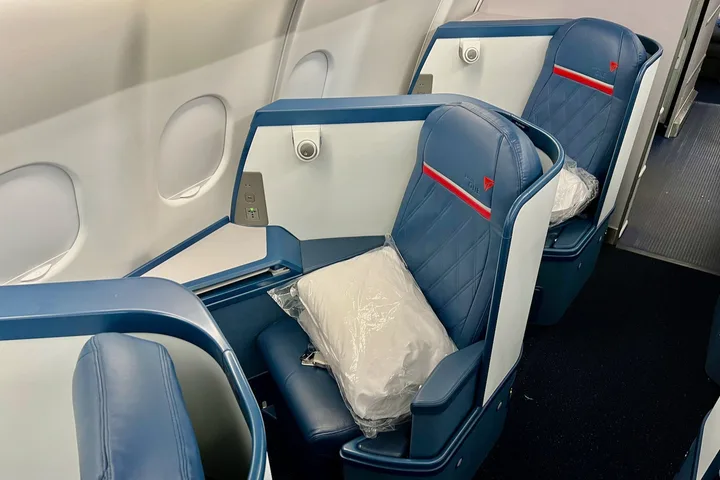
Not every ticket qualifies. Basic Economy passengers — those who booked the cheapest fares — are categorically excluded, full stop. Beyond that, all Delta Medallion elite members (Silver, Gold, Platinum, Diamond) and holders of the Delta SkyMiles Reserve American Express Card are eligible for complimentary upgrades on domestic U.S. flights, including Hawaii routes.
The eligible ticket types include paid fares, SkyMiles award tickets, Pay with Miles tickets, and SkyMiles Companion Certificates. What’s not on that list: Basic Economy, certain discounted corporate fares, and a handful of restricted ticket types Delta specifically excludes.
Medallion members also score complimentary upgrade eligibility on Aeromexico-operated flights within Mexico and between Mexico and the U.S., Central America, the Caribbean, Colombia, and Ecuador — which surprises a lot of people who don’t realize the benefit extends beyond Delta metal.
The Eight-Factor Pecking Order
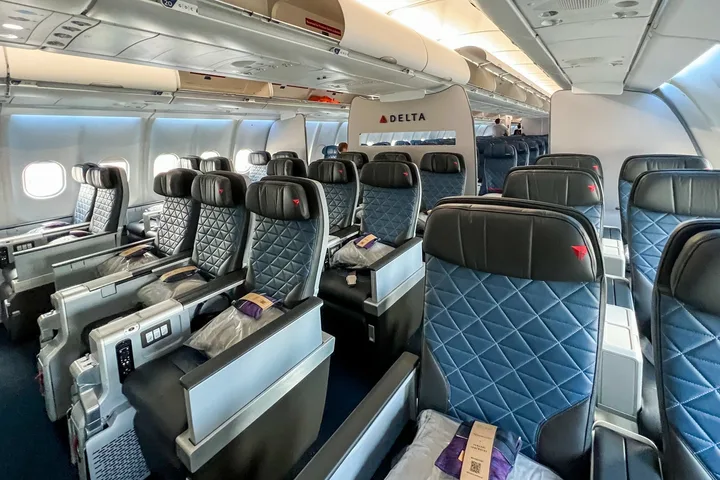
When a first-class seat opens, Delta doesn’t flip a coin. It runs every eligible passenger through an eight-factor priority list. Medallion tier sits at the top: Diamond beats Platinum beats Gold beats Silver, every time. Below that, the cabin you originally purchased matters — a refundable Delta Comfort ticket ranks above a nonrefundable Main cabin fare, which ranks above an award ticket in the same cabin.
Third is whether you hold elite status on multiple qualifying airlines. Fourth is Travel Experience tier — Extra clears before Classic. Fifth is Reserve card holder status. Sixth is Delta corporate travelers, provided the ticket includes the employer’s corporate ticket designator. Seventh is the total Medallion Qualification Dollars earned in the current calendar year. Only if two passengers are tied through all seven factors does the eighth factor — the date and time of the upgrade request — break the deadlock.
That last point is the one people misunderstand most. Requesting an upgrade early almost never helps you unless you’re already tied with someone else at every other level. If a Diamond member requests an upgrade three hours before departure, they’ll still clear ahead of a Silver who requested it three months ago.
The Windows That Actually Matter
Diamond and Platinum Medallion members start clearing into Delta First five days — 120 hours — before departure. Gold members begin clearing at 72 hours. Silver members at 24 hours. For Delta Comfort upgrades, Diamond and Platinum can clear immediately upon booking. Gold waits until 72 hours out, Silver until 24 hours.
Miss your window and you’re not done. Any pending upgrade request automatically rolls onto the airport standby list. Gate upgrades still happen, particularly on less competitive routes or when last-minute cancellations open seats. The list is re-ranked at the gate using the same priority hierarchy.
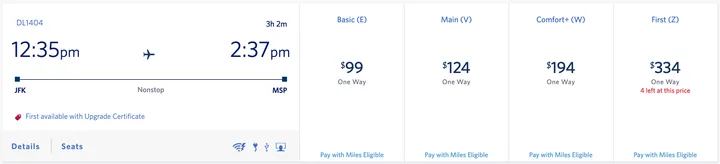
It’s also worth knowing that upgrade certificates and miles-based upgrades rank above all complimentary upgrades. So even a Diamond Medallion member waiting for a free bump can be leapfrogged by a Platinum using a Regional Upgrade Certificate. The certificate holders are at the front of the front of the line.
The Certificates That Skip Everyone
Regional Upgrade Certificates (RUCs) and Global Upgrade Certificates (GUCs) are the premium tier of Delta’s upgrade ecosystem. You can only get them one way: earn Platinum or Diamond Medallion status and select them as Choice Benefits. Diamond members choose from three options — eight regional upgrades, six global upgrades, or two global upgrades plus four regional ones. Platinum members get four regional upgrades as their single Choice Benefits selection.
The difference between the two is significant. RUCs work on domestic Delta First routes and the domestic Delta One experience. GUCs work everywhere RUCs do, plus international Delta flights and select partner-operated routes on Air France, KLM, Virgin Atlantic, Korean Air, and Aeromexico. One certificate covers one-way travel, so a round trip for you and a guest burns four of them.
Certificates clear immediately upon request if space is available — no waiting for a 72-hour window. If you book a Delta Main ticket and apply a certificate, the upgrade goes to Premium Select. From there, you land on a Delta One waitlist at the 24-hour mark. It’s theoretically possible to start in economy and end in a flat-bed seat, though there are no guarantees past Premium Select.
Applying Certificates Without Burning Them Wrong
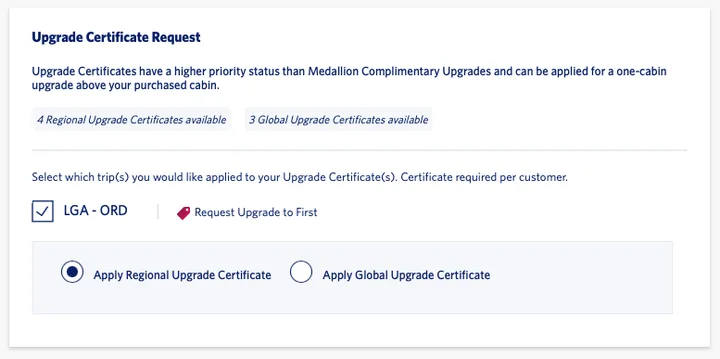
New Delta-operated bookings can be upgraded with a certificate directly on the Delta website or through the Fly Delta app. Look for the “Upgrade Certificate Request” box at checkout, select the flight, choose your certificate type, and it applies automatically when you complete the purchase. Existing bookings and any partner-operated flights still require a phone call to 800-323-2323 — call at least three hours before departure, though 24 hours is strongly recommended.

On itineraries with connections, this is where people make costly mistakes. If you don’t specify which leg you want upgraded, Delta will apply the certificate to whatever leg clears first. You could burn a GUC on a 40-minute regional hop while you ride economy across the Atlantic. Call the agent and be explicit: name the long-haul leg, confirm the certificate is applied only there. Once an upgrade clears on any leg, the certificate is considered used. There is no undo.
“Once it’s burned, it’s burned.”
Also: if your certificate fails to clear, it’s automatically reissued. But if it clears on the wrong leg because you didn’t specify, that reissuance doesn’t happen. The certificate is gone. This is not a theoretical scenario — it happens regularly on West Coast-to-Hawaii routes, where upgrade space is notoriously tight and clearing on a short positioning leg is common.
The Moves That Actually Improve Your Odds

Avoid flying Sunday nights, Monday mornings, and Fridays. These windows are loaded with top-tier frequent flyers — Diamond and Platinum members who fly 50,000+ miles a year and hold Reserve cards. Flying Tuesday or Wednesday afternoon means competing with a thinner field. Fewer competing upgrades, better shot at the front cabin.
For passengers below Diamond tier, opening a Delta SkyMiles Reserve American Express Card is the single fastest way to jump the queue. It slots you in at priority level five — above corporate travelers, above MQD totals, above the timestamp of your upgrade request. Combined with Medallion status, a Reserve card meaningfully shifts your position on the list on competitive routes.
On the certificate side, check upgrade availability before requesting. Delta shows available upgrade space on the flight search results page when you’re logged into an elite account. If the space shows as available, an immediate certificate confirmation is likely. If it’s waitlisted, on routes like LAX-HNL or JFK-LHR, the probability of clearing drops sharply. Use your certificates where they’ll actually clear — not where you’re hoping the list thins out by departure.